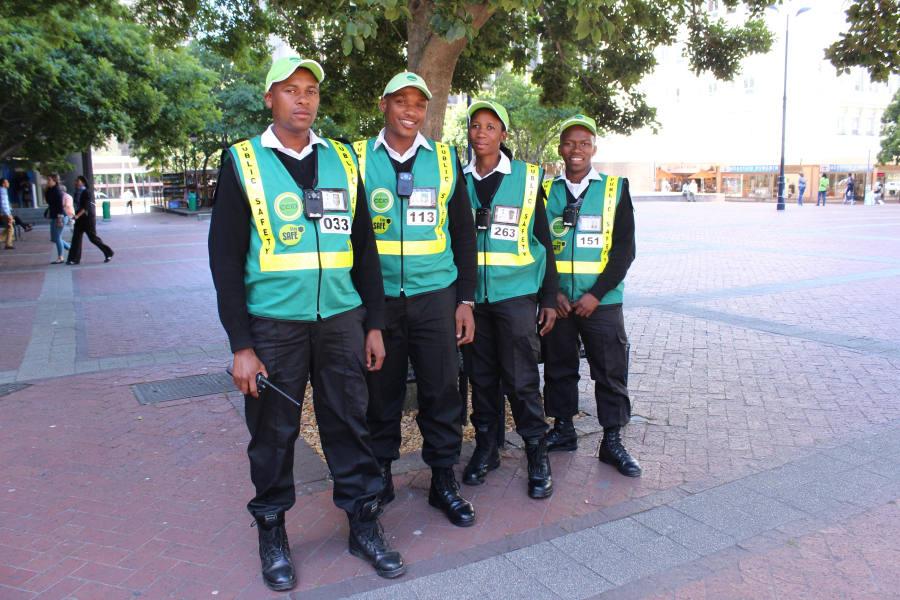
The Cape Town Central City Improvement District (CCID) has completed the training and rollout of body-worn video (BWV) units to all its on-the-ground public safety officers (PSOs).
The decision was taken after a nine-officer pilot project run over last year’s festive season proved to be a huge success in modifying the behaviour of both members of the public and the CCID’s own public safety officers.
According to Muneeb Hendricks, manager of CCID Safety & Security, the BWV units are now carried by all on-duty PSOs. “We have purchased 85 units in total and currently use 81 of these to equip the officers, who are on duty 24/7 during a normal deployment. Each one of our officers has been fully trained to operate his or her unit effectively and efficiently, and we have a number of units on standby should one go down at any time.”
Training has been undertaken at the CCID’s own full-time training facility in the Cape Town CBD, with each PSO being taught the operation and capabilities of the unit, including the different shooting modes; for example, video mode, voice recording, infra-red or after-dark recording, and stills camera functionality. The officers have also been trained in assessing the path of the laser guide (which shows where the camera is pointing, to ensure an optimal camera angle) and how to speak about what is being filmed while the camera is recording, so that an auditory track is available to complement the visual recording.
As is done each year, the CCID will once again be deploying additional officers during the festive season to cope with the influx of visitors. These PSOs will also be equipped with units, on a four-month hire from the supplier, and trained before deployment.
However, the cameras themselves are only part of the crime-fighting initiative: the CCID also purchased a Digital Evidence Management System (DEMS) to enable all footage from incidents to be stored in order to protect the chain of evidence, should any footage be required in the event of an investigation.
“In addition to the training of our PSOs,” says Hendricks, “we also have three managers, trained by the service provider Doculam, who are now completely au fait with the DEMS in terms of the download, storage and dissemination of footage shot.”
This backend system is as important as the units carried by the PSOs themselves, explains Tasso Evangelinos, CEO of the CCID: “Only the administrator of the system can delete footage, not the officer carrying the unit. Therefore, if an officer misbehaves while on duty, that officer cannot delete the footage of the incident.”
While a number of BWV camera units only record from the time they are activated, those purchased by the CCID have a continual 30-second rollup. In other words, explains Hendricks: “This means that from the time the record button is pressed, the camera has actually already been running for 30 seconds, continuously, in the background and is able to capture the initial scenario that would have sparked the officer’s attention. Usually, with other units, one only sees what happened ‘after the fact’ and not what actually cased the incident.”
In terms of PSOs using their own initiative as to which incidents to record, Hendricks continues: “This decision is taken out of the hands of the officer. It is his or her standard operating procedure to start recording as soon as they feel any incident is unfolding and if that is not done, the PSO will undergo disciplinary action. If a failure to record happens repeatedly, it could result in the termination of that PSO’s employment with the CCID.”
All footage relating to an incident in which an investigation has been launched is permanently stored on the server, while all other footage recorded is kept for a 30-day period. “If, after that time, we receive no enquires regarding an incident that has been recorded, then the footage for that incident will be cleaned off the hard drive by the administrators,” says Evangelinos.
Adds Hendricks: “BWV cameras are cutting-edge technology for law enforcement services globally, and their aim is to keep everyone – both our PSOs and members of the public – on the side of the law, honest and well-behaved. It’s about both behaviour modification and accountability.”
As for the CCID PSOs themselves, says Hendricks: “They love these units as they realise the system not only protects them when complaints are received but it also gives them a chance to showcase their skills in dealing with issues, particularly under often very trying circumstances.”
A particularly important aspect of the deployment of the CCID’s new BWV units is to ensure the rights of the public are protected, says Evangelinos: “These units have substantially reduced the number of investigations conducted, and has taken the ‘he said, she said’ guess work out of a situation. We are now able to make a well-informed decision on what the incident actually entailed and whether the rights of a member of the public were infringed in any way.”
Footage is also used in the training of new recruits to introduce them to what they can expect on the streets and the best way to handle incidents. “Plus,” says Hendricks, “the footage will always be made available in criminal cases as required and it will always be available to the City of Cape Town Law Enforcement agencies and the South African Police Service.”
Seen from left to right in the picture above are CCID public safety officers Mbulelo Jacobs, Ncedo Ngcabashe, Ntomizandile Mangwana and Siyabulela Mgogoshe.
If you would like to share the newsletter with anyone, view past issues or subscribe to receive the newsletter, please make use of the following link. http://eepurl.com/cnzn0r