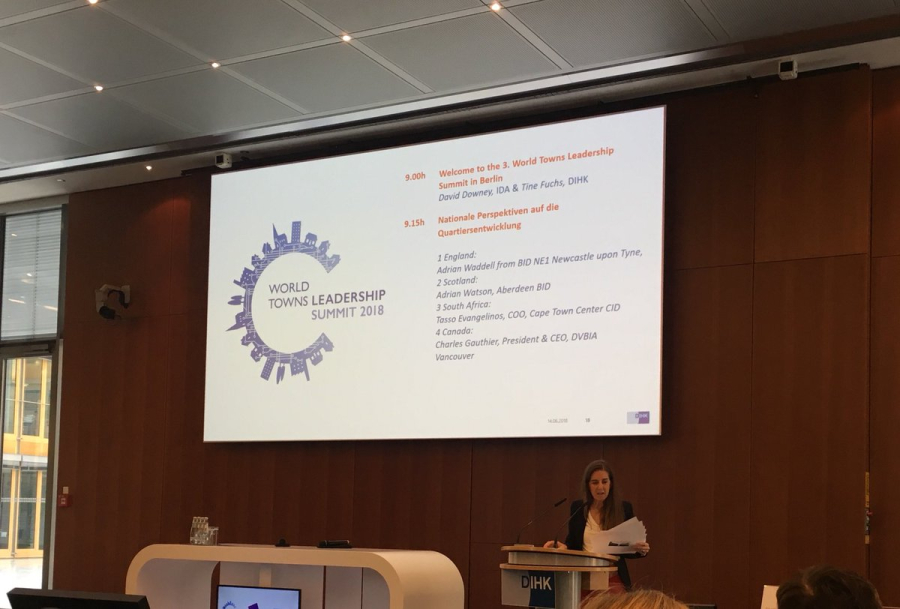
The Cape Town Central City Improvement District’s (CCID) CEO, Tasso Evangelinos, recently attended the 2018 World Towns Leadership Summit aimed at exploring the future roles of urban place management organisations in the smart city movement. Here are his impressions of the summit…
Says Tasso: “Having attended the second World Towns Leadership Summit in Sweden last year, I was certainly looking forward to this year’s summit and I wasn’t disappointed. The summit provided an excellent platform for sharing information, facilitating ideas and presenting opportunities for growth where City Improvement Districts (CIDs) are concerned. It was also a wonderful opportunity to showcase and promote the Cape Town Central City, as there is always an interest in what we have done to become a vibrant CBD for investment and a world-class live, work, play and stay destination that is welcoming to all.
“In terms of the smart cities movement, there was an open and honest reflection on questions such as: ‘Do we know what we want?’, ‘Who decides?’, ‘What are we planning for?’, ‘What will our cities look like?’ and we looked at how CIDs can be an instrument in all of this.
“When looking at the financial options challenge, some of the solutions that we explored included various sustainable financial solutions. And we also looked at the exciting different types of Improvement Districts (BIDs) or City Improvement Districts (CIDs) as they are known locally, that have emerged over the years such as food, public space management and digital BIDs.”
The event, now in its third year, was held from 18 to 20 June in Berlin, Germany and was organised by the Association of German Chambers of Industry and Commerce and the International Downtown Association (IDA).
Tasso further explains that the key points that were discussed in terms of the smart city movement included:
- Infrastructure – the role of urban design, spatial planning, smart buildings and how everything is now driven by Artificial Intelligence (AI).
- Mobility – ensuring accessibility is crucial and that people move around at a reasonable cost.
- Participation – our work requires that we work together with the people we serve and our communities, and this point highlighted the importance of building trust and relationships.
- Energy – as we will see more and more people moving into urban areas, smart cities will have to play their part in redefining their energy mix and looking at clean, sustainable energy.
“This was the start of a conversation,” concludes Tasso, “and it certainly has not ended as this summit once again highlighted the importance of the public and private sectors working together towards a shared goal, with organisations such as CIDs being important facilitators and enablers.”
Image by World Towns Leadership Summit