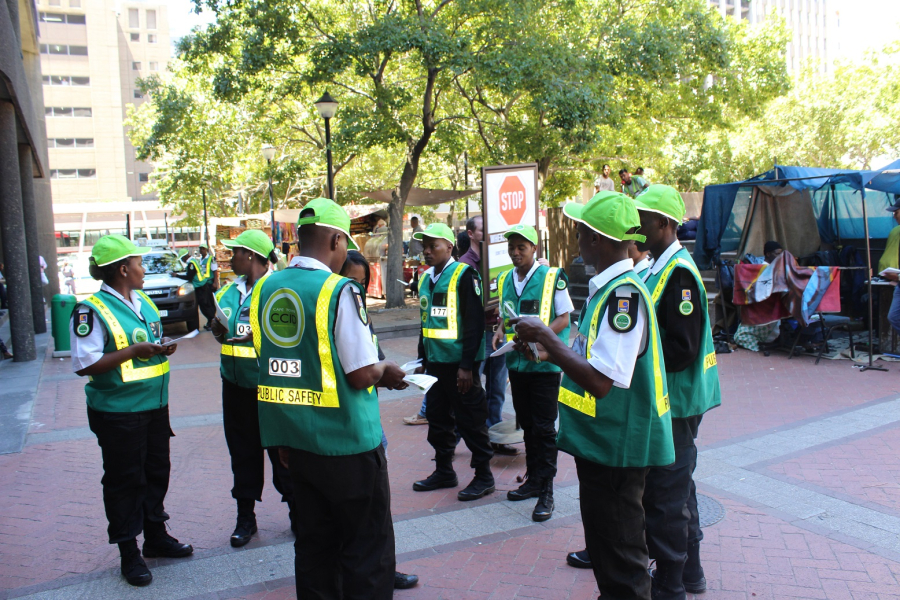
As a result of increased deployments by all law enforcement agencies, the Cape Town Central City Improvement District (CCID) has recorded a decline in major crimes in the Cape Town Central City over the 2017/18 festive season.
According to Muneeb Hendricks, manager of Safety & Security for the CCID, efforts to keep the CBD a safe place during the 2017/18 festive season have been successful, thanks to the collaborative efforts of law enforcement agencies working together.
“Along with the CCID’s own public safety team, this includes teams from the South African Police Service (SAPS), and the City’s own Metro Police, Law Enforcement officers and traffic wardens, all of whom increased their deployments and worked together to achieve a common goal, to ensure that both local and visiting holidaymakers stay safe in the CBD.
“Our strategy – to use both CCID incident reports and SAPS statistics to deploy officers to where they were needed the most ̶ is proving to be highly effective. Most members are deployed on foot to create a visible presence which serves as a deterrent to crime. Events management has also been a priority, particularly over December, with all agencies deploying large numbers during major events such as the switching on of the Festival of Lights, New Year’s Eve and the Cape Minstrel marches.”
Throughout the festive season, the CCID has been allocating an additional 10 staff members to concentrate on nighttime activity, and a special impact squad was also shifted to cover night activity concentrating on specific areas.
“This alone boosted the nighttime deployment by 22 members,” says Muneeb.
Throughout the year, a minimum of 70 CCID public safety officers – who are the most visible presence of the CCID in the Cape Town CBD in their bright green bibs and caps – patrol the streets around the clock. They can be found both on foot and in vehicles, and are in constant radio contact with the CCID’s 24/7 control centre (082 415 7127).
Muneeb notes that what has been particularly interesting this festive season is that there have been more local visitors in the CBD than usual: “We believe, with the tough economy, some people chose to stay put as opposed to travelling over the festive period, and instead enjoy what Cape Town has to offer. We saw large numbers of locals descending on the Central City to enjoy the nightlife, from our restaurants to our pubs and clubs.”

Throughout the festive season, the three most prominent types of crime that the CCID and its partners have been targeting are theft out of vehicles, pickpocketing and ATM fraud. To deal specifically with ATM fraud, the CCID has been rolling out an ATM Fraud Pilot Project together with the Western Cape Government’s Department of Community Safety (DOCS).
Muneeb elaborates: “The ATM Fraud Project is proving to be a major success and will continue in its current form until the end of February 2018. The project currently involves DOCS funding 15 security officers which the CCID manages and deploys to seven hotspot ATMs within the CBD.
“These seven ATMs were chosen due to high rates of incidents being reported at these spots of fraudsters targeting victims, and where approximately 50 cases of ATM fraud were reported between 15 December 2016 to 15 January 2017; in other words, during the 2016/17 festive season. However, with the new project, only two cases were recorded compared to the 50 cases during the same period last year within the areas of deployment while seven incidents were successfully prevented during the hours of our team being deployed.”
According to Fred Watkins of Security Risk Management at the Western Cape Department of Community Safety: “Identifying capable partners within communities is a critical element of the ‘whole of society’ approach to fighting crime and, as such, the efforts of the CCID within the Cape Town CBD must be recognised.
“The success achieved during December 2017 and January 2018 further demonstrates the importance of public/private partnerships. As of March 2018, the Department of Community Safety and the Department of Economic Affairs and Tourism will partner the CCID to expand this project to 25 ‘hot spot’ ATMs in the Cape Town CBD.
“This expansion will see 50 Chrysalis Academy graduates, trained in the safety and security field, deployed as safety ambassadors at these identified ATMs.”
The CCID’s own “Stash it, don’t flash it” awareness campaign, which uses ‘in-your-face’ messaging to sensitise the public not to become victims of crime, was also deemed to be highly effective. This included the erection of signposts in certain areas across town with vibrant safety alerts encouraging the public to be aware, and was accompanied by the hand out of important safety tips for visitors and locals alike.
It really was a team effort, stresses Muneeb: “Our six-member, CCID-funded traffic warden team also played a vital role; while the CBD was quieter during the usual peak traffic hours, we were able to use the wardens to assist the City’s traffic department with point duties during major events. And when not on point duty, the wardens dealt with offences such as double parking, blocking of loading zones and parking on red and yellow lines. For December alone, non-moving traffic fines issued amounted to R763 800. The largest number of offences recorded included unlicensed vehicles or failure to display a licence (R141 500), parking in a loading zone (R160 000), and parking in a manner causing danger and obstruction (R227 000).”
City of Cape Town Councillor, Dave Bryant, shares Muneeb’s sentiments about collaboration: “The ongoing cooperation between the City and the CCID has made a significant impact in improving the overall safety of the Cape Town CBD.”
Along with the work of the CCID, through ward allocation funding, Dave sponsors one additional Law Enforcement Officer dedicated to upper Long Street, which is considered the heart of the Central City’s entertainment district.
Explains Dave: “This officer has made a significant impact in Long Street, issuing fines in excess of R75 000 a month on traffic and by-law offences.
“As one of South Africa’s most congested cities, we will continue to have challenges relating to traffic management. However, we are committed to working with the CCID and other partners to help address these, and other challenges facing the Central City, through targeted interventions.”

In addition to the other festive season plans, and again together with the Western Cape Government DOCS, the CCID has a project running in The Company’s Garden aimed at creating a visible presence in this iconic space during the daytime by deploying a team of 15 ambassadors. The ambassadors are trained by the Western Cape Government’s Chrysalis Academy (as previously mentioned in terms of the extended ATM project) which is funded by DOCS and managed by the CCID.
Muneeb says: “The team we deploy in The Company’s Garden ensured that this iconic and popular visitor attraction had a visible presence in terms of the student team to assist people in general as well as prevent crime from occurring.”
Adds Fred: “The success of The Company’s Garden partnership between the Department of Community Safety and the CCID is evident in that together we can achieve more, not only in reducing crime but also in creating employment opportunities for our youth.”
Furthermore, says Muneeb, the CCID also ran a public space management project in conjunction with the City of Cape Town in St Georges Mall and Greenmarket Square which enjoyed a dedicated team of 13 CCID public safety officers and two City Law Enforcement officers.
The current festive safety plans that have been implemented by the CCID, together with its law enforcement partners, will continue throughout what is considered to be the main festive period until the end of March.
Images by Scott Arendse (CCID)