
During her successful five-year tenure, Julie-May Ellingson lived, worked and breathed the Cape Town International Convention Centre’s mantra of “shaping tomorrow today”. The former CEO bade the award winning establishment – and Cape Town – good-bye in January. We caught up with her before she left and asked her to take stock of the world-class venue’s achievements, from its hugely impressive growth in revenue to job creation and driving the knowledge economy.
You are leaving the CTICC after five extraordinary years. What will stand out as your greatest achievement/s?
The most obvious is the CTICC 2 expansion project, which was all-consuming, gave us all lots of grey hairs, but I believe the end result was worth it. Then there is the incredibly passionate and committed CTICC team, which I had the privilege of leading and from whom I have learnt so much. I am going to miss them terribly. I am very proud of our financial achievements over the past five years especially our 61 % growth in revenue, almost 115 % growth in EBITDA and an overall 86 % BBBEE spend, to name but a few. And finally, the training programmes including the graduate programme that was introduced in 2016. These programmes have provided staff with significant skills and benefitted the industry as a whole.
What was the most surprising element of your tenure as CEO?
I was aware of Cape Town’s international reputation as a tourist destination but was surprised at how well-regarded the CTICC was as a business. I was constantly invited to speak at conferences about the CTICC and how we operate. The CTICC is without doubt considered a world-class venue that others are eager to learn from. This is testament to the CTICC Team and the city. From an industry perspective, I have been amazed at the collaborative approach of the tourism sector in Cape Town. Businesses are genuinely willing to engage and help each other for the benefit of the industry as a whole. This has huge benefits for the city.
The economic impact of the CTICC has always been very impressive. In the 2018/19 economic year it contributed R6.5bn to the SA national GDP and R4.5bn to the Western Cape GDP. How have you managed to make this economic contribution so consistently?
Our economic impact is determined by our expenditure, as well as the expenditure of our clients and the delegates we attract. It is therefore critical for us to increase the number of events we host as well as attract those events that will contribute the most to the economy. In terms of GDP, our approach has always been to maximise our local spend to ensure that local businesses benefit from the work we do. At least 87 % of our total procurement is with locally based businesses. This equated to R331m in the last financial year alone.
From job creation to the CTICC’s social contribution, which aspect of the CTICC’s achievements stand out for you?
The CTICC follows a triple bottom line approach to business, often referred to as people, planet and profit. This means all three elements are equally important to us and one element cannot be achieved at the expense of the other. I am very proud of our contribution to job creation particularly in an economy that is shedding jobs. We have managed to increase our contribution to employment year on year. In the past financial year, we created, and sustained, over 14 600 jobs and have created/sustained over 54 000 jobs over the past five years. Giving back is part of the CTICC’s DNA and our investment in corporate social responsibility initiatives has more than doubled in the past five years. CTICC team members understand how privileged we are to be employed, and the majority are involved in community projects. We have also increased the number of CSR partners who are nominated by the staff. From an environmental perspective, much has been achieved not least of which is the construction of our reverse osmosis plant. We are now able to produce our own water, and no longer use any municipal water which means no matter which events we host, big or small, we will not place a burden on the municipal water supply.
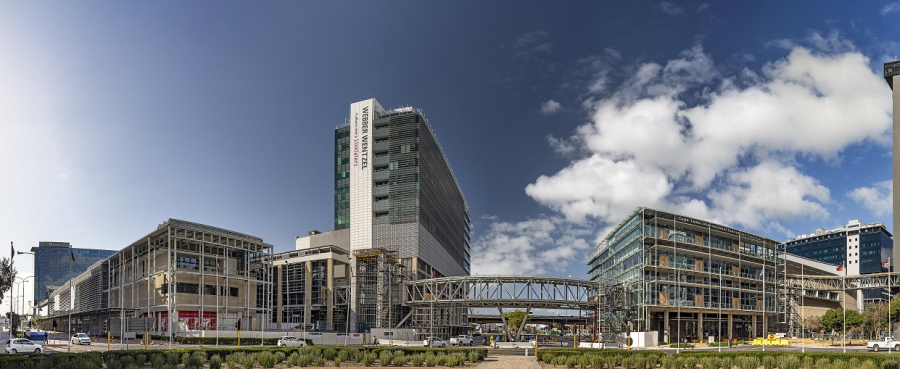
Above: Cape Town International Convention Centre
Which conferences have you felt very proud to host over your five-year tenure?
There are so many conferences, exhibitions and trade fairs which have made a positive impact that it is difficult to identify any one in particular. I have always believed the role of the CTICC is to drive the knowledge economy as well as provide a platform for South African and African delegates to share their expertise. The CTICC has also attracted a number of International Association conferences which have never previously been hosted in Africa. In addition to the knowledge exchange, these conferences, exhibitions, trade fairs etc. result in further investment in our city, province and country.
Supporting women-owned businesses has been important to you. Can you elaborate on why and how you made it work for the CTICC?
Gender equality has always been important to me. I am passionate about empowering women and ensuring we are given an equal opportunity. Over the past five years, we have promoted a number of women into management and executive positions. We have also achieved a substantial growth in our procurement from women-owned businesses, with almost 40 % of our total procurement being with women owned businesses (and this almost doubled within past five years). Having said that, I believe we can to do more and I hope this will remain a priority for the CTICC.
What does the future hold for you professionally and personally?
My husband and I are taking a six month sabbatical and will then be relocating overseas for a few years. I hope to complete my doctorate or MBA (haven’t decided which) in the next few years and look forward to more travelling and adventures.
LEADING THE CTICC INTO THE NEXT DECADE

Above: Taubie Mothlhabane
Cape Town’s world-renowned convention complex has a new CEO: Taubie Motlhabane has taken over the helm of the CTICC following the departure of her predecessor, Julie-May Ellingson.
The former Executive Director of the Tshwane Convention & Visitor Bureau, as well as Business Tourism Manager for South African Tourism, Taubie is well-versed in the events industry. She holds a Master’s degree in global marketing and an undergraduate degree in Communications, and has 29 years’ experience in both the public and private sphere.
Deon Cloete, Chairperson of the CTICC Board, said Taubie’s expertise was complemented by her extensive knowledge in strategy development, business planning, the business events industry and marketing. “It is clear to us that she will add significant value as CEO of the CTICC,” he said. Julie-May Ellingson said she was handing over the reins “with pride” to “another knowledgeable, passionate and strong woman”.
Taubie said she was excited about building on the world class eventing venue’s many successes. “I know that the sector is a dynamic industry, and one with so much potential. I intend to strategically harness and unlock this possibility and build on the centre’s stellar reputation on the global stage.
ECONOMIC IMPACT OF THE CTICC 2018/2019
- R6.5bn contribution to SA National GDP
- R47.3bn cumulative contribution to SA National GDP
- R4.5bn contribution to Western Cape GGP
- R39.6bn cumulative contribution to Western Cape GGP
- 14 620 total jobs created in 2018/2019
- 87% of total procurement spend with locally based suppliers
- 52% women employed in the business
IMAGES: Cape Town International Convention Centre (CTICC)
Note: The article appeared in the autumn edition of City Views.